Share
.png)


Lorem ipsum dolor sit amet, consectetur adipiscing elit. Suspendisse varius enim in eros elementum tristique. Duis cursus, mi quis viverra ornare, eros dolor interdum nulla, ut commodo diam libero vitae erat. Aenean faucibus nibh et justo cursus id rutrum lorem imperdiet. Nunc ut sem vitae risus tristique posuere.

November 14, 2025
Every leader wants a high-performing team, one that consistently meets deadlines, solves problems creatively, collaborates seamlessly, and communicates like a well-oiled machine. But here’s the truth most organizations overlook:
Performance problems are often communication problems in disguise. Missed expectations, Breakdowns between departments, Projects that stall, Team friction, turnover, or disengagement? Most roads lead back to weak communication, not weak people.
That’s exactly why workplace communication has become one of the most important competitive advantages for modern companies. It influences culture, collaboration, leadership, decision-making, and ultimately revenue. At The Vault Unlocked, Kayvon Kay often says this on the podcast:
“Communication is the bloodstream of your culture. When it flows well, the entire organization thrives.”
This article outlines 10 compelling reasons why effective communication is crucial in the workplace, supported by research, real-world examples, and leadership principles.
By the end, you’ll walk away with a crystal-clear understanding of how communication impacts performance, and what great leaders do to elevate it.
Great teams don’t run on luck; they run on trust. Trust is impossible without clear and consistent communication.
When communication is transparent:
According to SHRM, organizations with high-trust cultures experience lower turnover and higher productivity because people feel psychologically safe.
Poor communication is expensive. In fact, according to Gallup’s State of the Global Workplace: 2025 Report, global employee engagement dropped to about 21%, which Gallup estimates translates into $438 billion in lost productivity.
Clear communication helps teams:
When your team knows the what, why, and how, the work accelerates. This is why Kayvon teaches communication frameworks inside leadership workshops on The Vault Unlocked Podcast. Clarity is a leader's true superpower.
Employees aren’t disengaged because they’re lazy. They’re disengaged because they’re disconnected. The #1 indicator of employee engagement is quality conversations with leadership.
Harvard Business Review highlights that companies with strong communication cultures see:
Engaged teams communicate while disconnected teams retreat.
Motivational posters or corporate handbooks don’t create culture. Culture is created by the conversations people have every day.
When communication is siloed, culture becomes fragmented. On the other hand, when communication is intentional, culture becomes unified. This is why companies turn to leaders like Kayvon to help build cultures where communication becomes a strategic asset.
Conflict is inevitable. But confusion is totally preventable. Most internal conflicts aren’t caused by real issues; they’re often caused by:
Effective communication transforms conflict from destructive to constructive by:
Teams that communicate well don’t fear conflict; they resolve it more quickly and learn from it.
Leadership is communication. A leader’s ability to influence depends on their ability to:
Without strong communication, even the best strategic plans fall flat. On The Vault Unlocked Podcast, Kayvon emphasizes: “Your team doesn’t follow ideas. They follow clarity.”
Because great communication makes great leaders.
Sales blames marketing, marketing blames product, and product blames leadership. This is a familiar scenario. Siloed communication destroys collaboration.
When communication flows across departments:
This is especially critical for hybrid and remote teams where collaboration depends on intentional communication systems.
A team that communicates is a team that grows. Coaching, mentoring, feedback loops, and peer support all require clear communication channels.
High-performing organizations communicate through:
According to McKinsey & Company, Organizations whose leaders successfully empower others through coaching are nearly four times more likely to make good decisions than those whose leaders don’t and to outperform industry peers financially.
When communication strengthens, performance follows.
Externally, communication impacts:
Internally, poor communication leads to slow responses, inconsistent messaging, and customer frustration.
Effective internal communication leads to exceptional external experiences. This is why brands known for customer loyalty invest heavily in communication training across all roles, not just customer service.
When communication breaks down, alignment and performance suffer. Alignment requires clear communication around:
This is the foundation of a high-performance culture. As Kayvon often says:
“Alignment isn’t accidental, it’s the result of intentional communication.”
Companies with aligned teams grow faster, innovate more, and outperform competitors.
The SaaS and tech world moves at lightning speed. Features evolve weekly. Roadmaps shift overnight. Customer expectations change by the hour.
In this environment, communication becomes the glue that holds innovation together, preventing it from slipping into chaos.
Strong communication enables teams to:
When communication breaks down in a SaaS company, the consequences are immediate: delayed launches, confused customers, and frustrated teams.
In B2B selling, the deal often comes down to one thing: How well you communicate value, trust, and certainty.
Here’s where communication plays a strategic role:
Misaligned messaging means lost deals. And aligned communication equals higher win rates.
It’s no coincidence that top B2B sales teams communicate more, synchronize more, and consistently share insights; they treat communication as a revenue driver, not a soft skill.
In consulting, you don’t just sell expertise. You sell clarity, confidence, and communication.
Clients expect consultants to:
Here, communication isn’t a “skill”, it’s the product. When communication is strong, clients trust you, and when communication is weak, clients question everything.
That’s why elite consulting firms invest heavily in communication training, because authority is communicated long before it’s proven.
Startups don’t fail because of bad ideas; they fail because of misalignment. When a company is growing fast and everyone wears multiple hats, communication becomes the operating system that holds the entire business together.
Strong communication helps startups:
Weak communication creates chaos, burnout, and endless “fire drills.” High-performing founders build communication into the foundation of their culture, from all-hands meetings to Slack etiquette to decision-making frameworks.
As Kayvon often says on The Vault Unlocked Podcast:
“Startups don’t scale because they talk more; they scale because they talk better.”
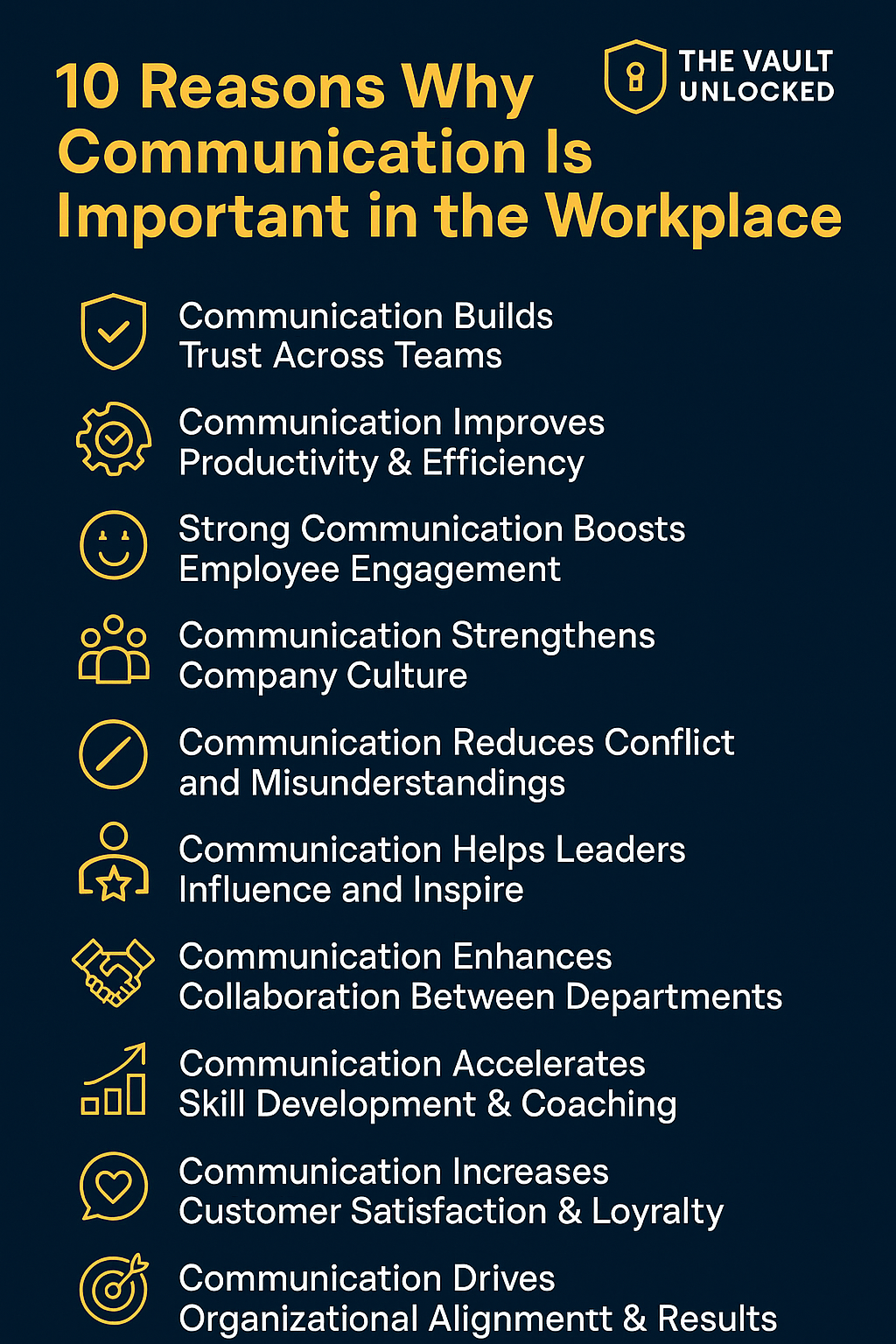
Communication isn’t just a workplace skill; it’s the foundation of performance, culture, leadership, and long-term success.
Teams with strong communication:
Teams without it? They crumble under misalignment, conflict, and missed expectations. If you want your organization to perform at the highest level, communication must become a core leadership priority, not an afterthought.
For deeper insights into leadership, communication, and performance psychology,
Or take the next step in building a high-performance culture: Work with Kayvon Kay through consulting, training, or executive coaching.
Because leaders can’t influence, motivate, or align teams without communicating clearly and consistently.
Assumptions, unclear expectations, lack of feedback, siloed departments, and poor listening.
Structured communication systems—weekly syncs, clear messaging frameworks, and consistent leadership communication.
It reduces mistakes, increases clarity, accelerates decision-making, and builds trust.
Even more. Remote teams survive on clarity, expectation-setting, and intentional information flow.
Kayvon Kay
Kayvon has over two decades of experience working with high-level closers and perfecting his sales methodologies. He has earned the title of Canada’s #1 pharmaceutical sales representative and continues to share his expertise as a keynote speaker and through his multi-million-dollar coaching program.